
Sunday, May 15, 2011
Water Harvested!
My daughter blamed our water tank on facebook for the drought in Texas because it hasn't rained since we put in the water harvesting shed. However, last Wednesday and Thursday we had some storms roll through and we anxiously looked forward to seeing if the Austin rain also hit our land east of home. And as we drove up, we were overjoyed to see, WATER!
 Our rain gauge recorded 8/10ths inch of rain (our neighbors had 9/10ths). The tank shows 125 gallons of water, but there was about three inches already in the tank from two times we got a trace of rain. As nice as this picture is, we won't see it like this in the future because we wrapped the tank in a black cloth to inhibit the growth of algae.


Sunday, April 17, 2011
Paucity of Precipitation
For those who follow Die Weide I owe an apology for not writing in a while. We have been out to Die Weide every weekend, but the hours I've been working the past month have resulted in a dearth of energy for writing the blog.
And we move the the critical dearth on Die Weide - a paucity of precipitation. I saw a weather report last week where the meteorologist stated that of the six or seven rain events since January, none has produced more than two-tenths of an inch of rain. Indeed, only one produced more than one-tenth of an inch of rain. So there, upon Die Weide stands a shed with a water harvesting tank that has only collected enough rain to water the orchard trees once. So our last four or five weekend visits have consisted of filling water barrels and coolers at home and watering the orchard and garden by hand. Thus, my writing of Die Weide wouldn't have consisted of much beyond, "this week, we watered the garden and orchard."
Two weeks ago we had a change of pace in that we invited Mom, Janice, and Kenny out for a BarBQ. Below are a couple of pictures of that family outing. It is great to see that Mom has recovered enough to be able to travel out to Die Weide and enjoy an outing.

 Last week Inge and I watered the garden and orchard and hacked a path through brambles next to the creek. The pond still has water, but the level is dropping very rapidly. If we don't get rain soon, we will again have a muddy hole in the creek - the state it was in during the drought last summer. Here a couple pictures of a very primitive garden. Also, even in a drought, we manage to find a few wild bluebonnets on Die Weide.

This week Inge and I watered the garden and orchard and for a change just went exploring. I set out with camera and notebook to try to identify a few trees on Die Weide. I will write later of my findings. Here again are garden pictures Inge took today. Note the corn is growing nicely.
 In this photo, there are six tomatoes, four store bought tomato plants and two that spontaneously grew from compost leavings in our back yard garden. We have so many of these wild tomatoes that I chose two to move out here. Note how vigorous the wild tomatoes up front appear compared to the greenhouse tomatoes in back! If it looks a little rough it's because we used leaf litter as mulch.

And we move the the critical dearth on Die Weide - a paucity of precipitation. I saw a weather report last week where the meteorologist stated that of the six or seven rain events since January, none has produced more than two-tenths of an inch of rain. Indeed, only one produced more than one-tenth of an inch of rain. So there, upon Die Weide stands a shed with a water harvesting tank that has only collected enough rain to water the orchard trees once. So our last four or five weekend visits have consisted of filling water barrels and coolers at home and watering the orchard and garden by hand. Thus, my writing of Die Weide wouldn't have consisted of much beyond, "this week, we watered the garden and orchard."
Two weeks ago we had a change of pace in that we invited Mom, Janice, and Kenny out for a BarBQ. Below are a couple of pictures of that family outing. It is great to see that Mom has recovered enough to be able to travel out to Die Weide and enjoy an outing.


 | |
| Orchard Maintenance with Dog Following |
 | |
| Die Weide Bluebonnets |


Sunday, March 13, 2011
Primative Tarp Camping on Die Weide
Not having camped in over 20 years, I no longer owned a tent. But I've got tarps and a sleeping bag and a strong desire to camp again. I bought a lamp, and a cot to add to the supplies and Friday I left work early and headed out out to Die Weide for my first camping trip on our place.
First things first - I also purchased a Remington 597 .22 rifle for plinking and rabbit hunting (someday.) So I set up to shoot a few rounds to see how she fired. I brought a small screwdriver to adjust the iron sites, but found out that the elevation adjustment also required an allen wrench which I didn't have. I got the windage adjusted correctly but it shot high and I'll have to adjust that next time. Once I knew it shot high, I adjusted my aim and subsequently shot pretty good groups for rule-of-thumb low aiming.
After breaking in the .22 I started the fire in the pit, but it was very windy, so I constructed a windbreak from plywood, 2x4 scraps and a left-over sheet of steel. The wind break worked great Friday evening because the wind blew consistently from the South-South-East. Below you see a photo of my bacon burgers and home fries over the fire and a glimpse of the windbreak.
As the sun settled in the west, I recalled that one of my quibbles with our house in Cedar Park is I can not see a sunrise or sunset from any vantage point from our house because there are too many houses and trees to see the horizon. However, that's not a problem in the wide open spaces of Die Weide so I captured a nice sunset photo through the picnic pecan. Nothing spectacular, but the day will come when I will be able to take photos of a stunning sunset or sunrise. After dark I threw another log on the fire and brought out my guitar to serenade the wind, fire, and stars.
Here are my Friday evening fire and sunset photos.
I built my camp site by the light of my led cap light and the lantern I purchased earlier in the week. Taking advantage of the shed and a couple of handy 2x4s I draped and tied down the 8x10 tarp into a lean-to to keep the wind off from the south and added the smaller tarp to provide privacy and further wind protection from the east. The wind never let up over night and at one point, around 2:30 in the morning, I got up and tightened up the small tarp as it woke me often flapping in the strong breeze. I woke an hour before sunrise but snuggled a bit longer in the sleeping bag due to the cool morning. A warm sleeping bag on a cool morning is one of the few reasons I stay in bed after waking. Here is a photo of my tarp shelter. (Inge said it looks like a hobo camp...)
I stepped out before the dawn and scouted for rabbits with a telephoto lens on my camera. I never saw a rabbit, but did see and hear a lot of cardinals, who have a song as beautiful as they look.
After the rabbit-less wandering I fired up the pit and cooked up bacon and eggs for breakfast. The night before I covered the fire with dirt for safety and when I removed the dirt in the morning I found a few still-smoldering coals. So for fun I built my kindling and stick tee pee over the coals, stuffed in some dry grass, blew a little and in no time flat I had a fire without a match or lighter! I feared my breakfast fire a bit though because the strong winds from the night before became stronger and swirled far more, which blew a lot of sparks around. I worried that I might set the drought dried grass afire. I resolved then to cancel cooking for lunch. (Rats! I looked forward to yummy pork chops over the camp fire!)
The rest of the day I spent jumping on the shovel in the garden area to loosen the soil deeper than the plough reached. I only managed to cover a third of the garden as shovel jumping is wearing work. Afterward, I planted my corn and black-eyed peas and the rest I will plant bit-by-bit over the next couple of weeks. I am concerned that this might be a meager garden as La Nina has put us in a spring drought that has the soil a lot dryer than needed for good germination and growth. Although the water harvest shed and tank will hold a lot of water, it requires rain to fall first. And rain is something we've not had this spring. Inge and I have discussed and I've looked up on line several methods for putting in a shallow well as most of our neighbors have wells that produce water at 19' depth. If we don't get rain by June we'll throw in to drill a well to keep the garden producing.
First things first - I also purchased a Remington 597 .22 rifle for plinking and rabbit hunting (someday.) So I set up to shoot a few rounds to see how she fired. I brought a small screwdriver to adjust the iron sites, but found out that the elevation adjustment also required an allen wrench which I didn't have. I got the windage adjusted correctly but it shot high and I'll have to adjust that next time. Once I knew it shot high, I adjusted my aim and subsequently shot pretty good groups for rule-of-thumb low aiming.
After breaking in the .22 I started the fire in the pit, but it was very windy, so I constructed a windbreak from plywood, 2x4 scraps and a left-over sheet of steel. The wind break worked great Friday evening because the wind blew consistently from the South-South-East. Below you see a photo of my bacon burgers and home fries over the fire and a glimpse of the windbreak.
As the sun settled in the west, I recalled that one of my quibbles with our house in Cedar Park is I can not see a sunrise or sunset from any vantage point from our house because there are too many houses and trees to see the horizon. However, that's not a problem in the wide open spaces of Die Weide so I captured a nice sunset photo through the picnic pecan. Nothing spectacular, but the day will come when I will be able to take photos of a stunning sunset or sunrise. After dark I threw another log on the fire and brought out my guitar to serenade the wind, fire, and stars.
Here are my Friday evening fire and sunset photos.
 |
| Bacon burgers and home fries. (Windbreak at top) |
 |
| Sunset Through Picnic Pecan |
 |
| Enjoying the fire at night |
 |
| Hobo Tarp Tent |
After the rabbit-less wandering I fired up the pit and cooked up bacon and eggs for breakfast. The night before I covered the fire with dirt for safety and when I removed the dirt in the morning I found a few still-smoldering coals. So for fun I built my kindling and stick tee pee over the coals, stuffed in some dry grass, blew a little and in no time flat I had a fire without a match or lighter! I feared my breakfast fire a bit though because the strong winds from the night before became stronger and swirled far more, which blew a lot of sparks around. I worried that I might set the drought dried grass afire. I resolved then to cancel cooking for lunch. (Rats! I looked forward to yummy pork chops over the camp fire!)
The rest of the day I spent jumping on the shovel in the garden area to loosen the soil deeper than the plough reached. I only managed to cover a third of the garden as shovel jumping is wearing work. Afterward, I planted my corn and black-eyed peas and the rest I will plant bit-by-bit over the next couple of weeks. I am concerned that this might be a meager garden as La Nina has put us in a spring drought that has the soil a lot dryer than needed for good germination and growth. Although the water harvest shed and tank will hold a lot of water, it requires rain to fall first. And rain is something we've not had this spring. Inge and I have discussed and I've looked up on line several methods for putting in a shallow well as most of our neighbors have wells that produce water at 19' depth. If we don't get rain by June we'll throw in to drill a well to keep the garden producing.
Planting of Orchard and did I mention great neighbors?
I failed to publish last week even though we planted our first six peach trees in the orchard. Chalk it up to working 14 hour days and being too pooped to write.
We loaded the truck up with shovels, bags of mulch, a roll of wire fencing and so forth and headed out to Die Weide. I installed some gable trim but only did half the work because my boots were too slippery to work on the steel roof. Once I got down (carefully!) I started planning the tree spacing for the orchard. According to the Texas A & M ag web site, peach trees should have 9' foot diameter spacing and at least 18' on center from tree to tree. We mapped out a zig-zag pattern and dug holes and planted trees. As a bit of care and overkill, we put down black weed barrier cloth and covered that with mulch, leaving a space around the tree in the center as recommended in several articles. One thing a lot of articles said to do first was to kill grass and weeds around the tree area with herbicide, but I object to that and will take a chance with the weed barrier and mulch and diligent cutting/mowing of the area between the trees. I am not an organic fanatic, but don't feel comfortable dousing my land with herbicide. Our neighbor's fruit trees produce and look healthy and I don't see signs of weedkiller, so we'll see how that works out.
Did I mention great neighbors? The previous week I mentioned to Kenneth that I plan to rent a rototiller to put in a garden at the side of the shed and he said he had a plow that would turn over the sod. And there he came Saturday with the tractor and sod-busting plow. Although it took a bit of maneuvering around the shed, he plowed sod under for a 12' x 48' garden in which I plan to plant corn, greenbeans, black-eyed peas, watermelon, cantaloupe, and potatoes. He also mentioned that another nearby farmer was going to run a tractor-driven tiller over his garden and he might run it over mine too. So later that afternoon, I hear the tractor chugging along and here came Neil with a tiller to go over the freshly turned sod several times.
Here come the photos....
We loaded the truck up with shovels, bags of mulch, a roll of wire fencing and so forth and headed out to Die Weide. I installed some gable trim but only did half the work because my boots were too slippery to work on the steel roof. Once I got down (carefully!) I started planning the tree spacing for the orchard. According to the Texas A & M ag web site, peach trees should have 9' foot diameter spacing and at least 18' on center from tree to tree. We mapped out a zig-zag pattern and dug holes and planted trees. As a bit of care and overkill, we put down black weed barrier cloth and covered that with mulch, leaving a space around the tree in the center as recommended in several articles. One thing a lot of articles said to do first was to kill grass and weeds around the tree area with herbicide, but I object to that and will take a chance with the weed barrier and mulch and diligent cutting/mowing of the area between the trees. I am not an organic fanatic, but don't feel comfortable dousing my land with herbicide. Our neighbor's fruit trees produce and look healthy and I don't see signs of weedkiller, so we'll see how that works out.
Did I mention great neighbors? The previous week I mentioned to Kenneth that I plan to rent a rototiller to put in a garden at the side of the shed and he said he had a plow that would turn over the sod. And there he came Saturday with the tractor and sod-busting plow. Although it took a bit of maneuvering around the shed, he plowed sod under for a 12' x 48' garden in which I plan to plant corn, greenbeans, black-eyed peas, watermelon, cantaloupe, and potatoes. He also mentioned that another nearby farmer was going to run a tractor-driven tiller over his garden and he might run it over mine too. So later that afternoon, I hear the tractor chugging along and here came Neil with a tiller to go over the freshly turned sod several times.
Here come the photos....
 |
| Inspecting the plough |
 |
| Bustin' Sod |
 |
| The green twig is a peach tree. |
 |
| Critter Proofing Peach Tree (hopefully!) |
Monday, February 28, 2011
Water Harvest Shed - Ready to collect rain!
Sunday my brother Kenny and I headed out to complete the water harvest shed. The wind gusted constantly making the gutter installation a bear - to which Kenny commented while drilling another gutter screw hole, "ya know, professional gutter installers would be taking today off." But I didn't let him off that easy and we kept trucking such that by noon we finished installing the gutter and by 2:30 we installed and plumbed in the tank. Along the way neighbors dropped by brimming with questions and admiring the work, and one time as a pair of neighbors drove by in a golf cart the wind whipped their words by me, something to the effect, "(he) put the tank inside the shed!"
As another testament to the wonderful neighbors I've mentioned before, we were given several peach tree rootings that afternoon from their father's productive orchard. I can't get over how great everyone is around here!
As before, I'll let the pictures tell most of the story. In the last picture, the tank looks small within the shed because it is a temporary tank adequate to irrigate the first year of peach trees. Next year this 330 gallon tank will be moved outside the shed and replaced with a 1500 gallon tank. Together the 1830 gallons will provide sufficient water for an orchard of more than 20 trees, requiring supplemental water only in case of extended drought. As for the shed, all that's left is to install next weekend is the gable end trim. Later in the year, after building savings back up, we will install floors and walls around the tool shed part of the building.


As another testament to the wonderful neighbors I've mentioned before, we were given several peach tree rootings that afternoon from their father's productive orchard. I can't get over how great everyone is around here!
As before, I'll let the pictures tell most of the story. In the last picture, the tank looks small within the shed because it is a temporary tank adequate to irrigate the first year of peach trees. Next year this 330 gallon tank will be moved outside the shed and replaced with a 1500 gallon tank. Together the 1830 gallons will provide sufficient water for an orchard of more than 20 trees, requiring supplemental water only in case of extended drought. As for the shed, all that's left is to install next weekend is the gable end trim. Later in the year, after building savings back up, we will install floors and walls around the tool shed part of the building.


 |
| Construction Team! |
 |
| Details of the system |

Saturday, February 26, 2011
Steeling The Water Harvest Shed - Roofing, that is.
Inge had to work this weekend so my brother Kenny and I tackled the steel roofing without our construction supervisor. The weather forecast a few days ago was for a sunny breezy day today - they got that wrong on both counts. The good news was that the breezy part was wrong to the good side - it was, for Texas, a reasonably calm day. The sunny part of the forecast was wrong to the bad side though. We endured a cloudy drizzle almost all day. This made for slippery work installing the steel panels. I spent most of the day on the ladder and Kenny spent the day on the roof. I passed him panels, screwed the bottom down and he screwed the top and middle. And here we have a few photos of the work and the finished product.
 |
| Dark Dreary Drizzly Day - Roofin' |
 |
| Last Panel - Is that blue up there? |
 |
| Ridge Cap almost done |
 |
| Roofed Shed - Gutters and Tank tommorrow! |
Sunday, February 20, 2011
Gardening on the Home Front
No Die Weide work today because our backyard raised bed gardens called for our attention. However, to tie this activity back to a mention of Die Weide, I'll discuss my hopes for a two location garden strategy. A couple of pictures accompanies many levels of discussion.
Over the last four years I've constructed four raised garden beds and a grape arbor in our back yard. I constructed the latest addition, a picket fence, in defense of puppy digging. The back bed in this photo once stood verdantly filled with two years worth of strawberry plantings. This year we hoped to harvest our first serious bounty of strawberries. But two months of puppy digging deprived us of any hope of home grown strawberries this year.
Inge scattered a mixture of wildflower seeds we received as a Christmas gift which is now poking green into the foreground of the photo. We planted this same patch in corn last year, which produced nothing, and in potatoes two years ago, which produced a very nice bucket of potatoes which we enjoyed.
Above is a photo of our compost corner. Two halves of a portable wire dog cage saw second duty as a pair of compost heaps. Later I added stakes and wire to enclose a third heap between the two enclosures. Today, I scooped out the rich compost from the two bins and worked them into the raised beds, along with some bags of manure from home depot.
So how does this relate to Die Weide? It is my hope that this year we will plant the backyard garden with the primo veggies, like tomatoes, cucumbers, green beans, and lettuce. On Die Weide, I will dig up a small garden area into which we will plant the bulky and space consuming vegetables like potatoes, black-eyed peas, corn, perhaps some squash (though Inge and I aren't big fans of squash) and the sweet non-vegetables, watermelon and cantaloupe. Inge and I both have our doubts about this remote garden, but for different reasons. She doubts the water harvesting shed will produce enough water for a garden (for which I respond, God will provide), and I worry that a lightly attended garden will be gnawed away by the critters. Hopefully I can scrounge up enough fencing material to keep the critters at bay. One thing I don't worry about is the ability of Die Weide to produce. The soil there is richer than any soil I've worked with in my life. But any soil can be deprived of ability to provide a bounty if not replenished. On Die Weide I will construct the simple shipping crate compost heaps into which we will pile grasses cut from around the orchard, and eventually manure from the livestock we will graze.
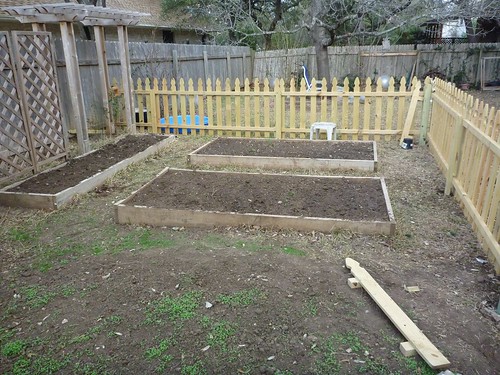 |
| Puppy De-Fenced Garden |
Inge scattered a mixture of wildflower seeds we received as a Christmas gift which is now poking green into the foreground of the photo. We planted this same patch in corn last year, which produced nothing, and in potatoes two years ago, which produced a very nice bucket of potatoes which we enjoyed.
 |
| Compost Corner |
So how does this relate to Die Weide? It is my hope that this year we will plant the backyard garden with the primo veggies, like tomatoes, cucumbers, green beans, and lettuce. On Die Weide, I will dig up a small garden area into which we will plant the bulky and space consuming vegetables like potatoes, black-eyed peas, corn, perhaps some squash (though Inge and I aren't big fans of squash) and the sweet non-vegetables, watermelon and cantaloupe. Inge and I both have our doubts about this remote garden, but for different reasons. She doubts the water harvesting shed will produce enough water for a garden (for which I respond, God will provide), and I worry that a lightly attended garden will be gnawed away by the critters. Hopefully I can scrounge up enough fencing material to keep the critters at bay. One thing I don't worry about is the ability of Die Weide to produce. The soil there is richer than any soil I've worked with in my life. But any soil can be deprived of ability to provide a bounty if not replenished. On Die Weide I will construct the simple shipping crate compost heaps into which we will pile grasses cut from around the orchard, and eventually manure from the livestock we will graze.
Subscribe to:
Posts (Atom)